 how-to
How to Fix Project Bottlenecks: A Step-by-Step Guide
Table of Contents
- Why Project Bottlenecks Stall Delivery and How to Spot Them Early
- Step 1: Map Your Workflow to Find the Constraint
- Project Management Bottleneck Examples You'll Recognize
- Step 2: Apply Resource Allocation Best Practices to Relieve Pressure
- Step 3: Learn How to Delegate Business Tasks That Clog Your Calendar
- Step 4: Cut Work-in-Progress and Set WIP Limits That Hold
- Step 5: Prevent the Next Bottleneck Before It Forms
- Frequently Asked Questions
Last Updated: September 30, 2026
Why Project Bottlenecks Stall Delivery and How to Spot Them Early
A project bottleneck is any single step in your workflow that moves slower than everything around it, capping how fast the whole job can finish. Learning how to fix project bottlenecks starts with finding that one constraint instead of pushing every task harder. At Roam Six, we see the same pattern in service businesses and construction firms: crews sit idle, clients wait, and nobody can say exactly where the delay begins.
The Real Cost of an Unchecked Constraint
One slow step sets the pace for your entire operation. If permits take three weeks and framing takes three days, faster framing buys you nothing. The work piles up behind the constraint, and your best people spend their time waiting, reworking, or chasing status updates.
Step 1: Map Your Workflow to Find the Constraint
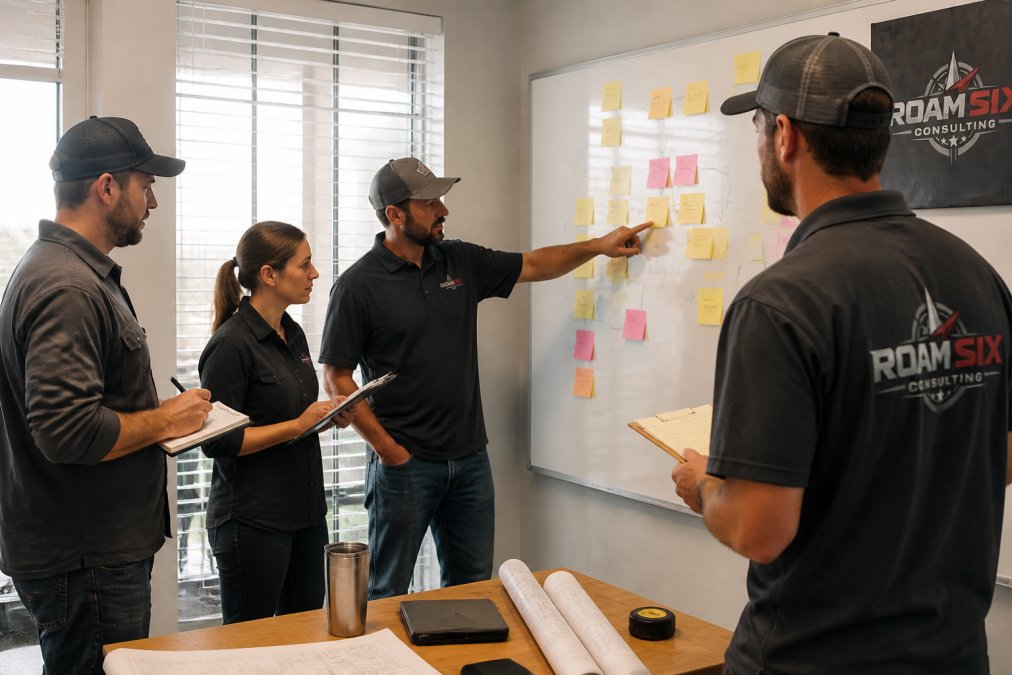
Mapping is not a whiteboard exercise you finish in an afternoon. It is a measurement pass. The goal is to find the single step whose throughput caps the whole job, then prove it with numbers instead of opinion.
- Cycle time, how long one unit of work takes from start to finish at that step (a permit package, a framing crew, a code review).
- Lead time, how long the client waits from request to delivery across the whole chain.
- Throughput, how many units that step can complete per day or week.
- Queue depth, how many units are sitting in front of that step, waiting.
A Worked Example
Say a service business moves 40 jobs a month through five stages:
| Stage | Throughput (jobs/week) | Queue depth |
|---|---|---|
| Intake | 12 | 1 |
| Estimating | 10 | 2 |
| Permitting | 4 | 9 |
| Field work | 8 | 3 |
| Closeout | 11 | 0 |
How to Measure Without a Consultant
- Log the date and time work enters and leaves each stage.
- Subtract to get cycle time per stage.
- Count how many items sit in each queue at the same time each morning.
- Sort by queue depth. The top of that list is your starting point.
The Human Signal You Should Not Ignore
Numbers tell you where the constraint is. They do not tell you how much it is costing you in people. Watch for the teams that sit adjacent to the constraint: if the same two or three people are consistently waiting, reworking, or chasing status, that is a morale problem forming in real time. Bottlenecks do not just slow delivery, they burn out the people downstream of them, and turnover at a non-constraint step can quietly become the next constraint.
Project Management Bottleneck Examples You'll Recognize
Most project bottlenecks fall into a handful of familiar types. Spotting yours fast saves weeks of guessing.
| Bottleneck Type | Warning Sign | First Fix |
|---|---|---|
| Approval | Everything waits on one signature | Set approval limits |
| Staffing | One expert is booked solid | Cross-train a backup |
| Information | Work restarts after missing details | Add a intake checklist |
| Equipment | One machine or crew is the only option | Schedule around it |
| Scope | New requests keep landing mid-job | Written change orders |
Step 2: Apply Resource Allocation Best Practices to Relieve Pressure
Resource allocation best practices start with matching your best people to the constraint, not spreading them evenly. Protect the slow step. Feed it first.
- Move one strong person onto the constraint full time
- Give the constraint a buffer of ready work so it never idles
- Stop starting new work the constraint cannot absorb
- Check capacity weekly, not quarterly
Step 3: Learn How to Delegate Business Tasks That Clog Your Calendar
Learning how to delegate business tasks is the fastest way to remove yourself as the constraint. Owners often are the bottleneck: every quote, every approval, every client call runs through one desk.
What to Hand Off First
- Repeating tasks you do the same way each time
- Work that someone else already knows how to do
- Decisions below a set dollar amount
- Scheduling, ordering, and routine client updates
Start with one task, document the steps, then hand it over with a clear limit: "Approve change orders under this amount without checking with me." That single move clears hours each week.
Step 4: Cut Work-in-Progress and Set WIP Limits That Hold
Work-in-progress is the number of jobs open at once. The more you open, the slower each one moves, because every open job competes for the same people, tools, and attention. Cutting WIP raises throughput even when total capacity stays the same, this is the counterintuitive part most teams resist.
How to Pick a WIP Limit That Is Not Just a Guess
A limit pulled out of thin air gets ignored within a week. Derive it from data instead.
- Measure the throughput of your constraint step (from Step 1). If permitting clears 4 jobs a week, that is your ceiling.
- Measure your average cycle time at that step. If it is 5 days, you can hold roughly one week of work in front of it without starving it.
- Set the WIP limit at the number of jobs the constraint can clear in one cycle, plus a small buffer, often one or two jobs.
Make the Limit Visible and Enforceable
A limit only works if everyone can see when it is hit.
- Put every stage on one board, physical or digital, with a hard column cap.
- When a column is full, no new work enters that stage. Period.
- Move finished work out before pulling new work in.
- Post the limit on the board itself so no one has to remember it.
Handling the Pushback
The two objections you will hear are predictable.
- "We will lose work if we say no." You will not lose the work, you will queue it. A written waitlist with honest lead times beats an overloaded pipeline that misses dates.
- "Our work is too varied for limits." Then limit by stage, not by job type. The constraint does not care what the job is; it cares how many units it can process.
The Morale Side of WIP
High WIP is not just a scheduling problem. When everyone is juggling ten open jobs, no one finishes anything, and the team ends the week with nothing to show for it. That is a direct hit to morale and a leading indicator of turnover. A visible WIP limit gives people the psychological permission to finish one thing before starting the next, which is the single biggest driver of both throughput and retention in bottlenecked teams.
Where Automation Actually Helps
A shared board with automatic status updates removes the manual tracking that eats hours and lets the WIP limit enforce itself. But do not automate a process you have not fixed. Software will happily scale a bad workflow. Set the limit by hand first, prove it works, then let a tool carry it.
Step 5: Prevent the Next Bottleneck Before It Forms
Once you fix one constraint, another appears. That is normal. The goal is to catch it early instead of after a missed deadline.
- Review cycle time every month for creeping delays
- Cross-train so no single person is irreplaceable
- Set a written change-order process to control scope creep
- Track one or two key performance metrics, not ten
Frequently Asked Questions
How do you identify a bottleneck in a project workflow?
Look for the stage where work piles up. Track cycle time and lead time for each step, then compare. The step with the longest queue and the slowest throughput is your constraint. Process mapping makes this visible: draw every handoff from project kickoff to delivery, then mark where tasks sit idle the longest. In most service businesses, the bottleneck sits with one overloaded person or one approval step, not with the whole team.
What are the most common causes of project bottlenecks?
The usual suspects are scope creep, uneven resource allocation, too much work-in-progress, and single points of failure where only one person can approve or complete a task. Poor team communication and unclear task prioritization make all of these worse. On construction and service projects, waiting on client decisions or permits adds another layer. Fixing the cause matters more than pushing the team to work faster at the constraint.
How does delegating tasks help prevent future project bottlenecks?
When one person owns every approval, quote, and client call, that person becomes the constraint. Learning how to delegate business tasks spreads decision rights across your team, so work keeps moving when you are in a meeting or on a job site. Start with repeatable tasks that follow a clear process, document the steps, and set a check-in cadence. Cross-training two people per critical role also removes single points of failure.
What is the difference between a resource bottleneck and a process bottleneck?
A resource bottleneck means you lack capacity, whether that is people, equipment, or budget, at a specific stage. A process bottleneck means the workflow itself is flawed: redundant approvals, manual data entry, or steps that create rework. The fix differs. Resource bottlenecks need capacity planning and workload balancing. Process bottlenecks need process optimization or automation. Diagnose which one you have before spending money on either.