 How-to
7 Business Process Improvement Steps That Cut Waste
Last Updated: November 15, 2026
Quick Summary
Business process improvement means mapping how a process actually runs today, then removing steps that cost time and money without adding value. Run process improvement as a five-step framework: select the process, baseline it, map it, redesign it, and control it. Measure cycle time, error rate, cost per transaction, and volume before changing anything.
- Score candidate processes 1 to 5 on customer impact, financial impact, risk, and feasibility, then use (Impact x Feasibility) / Effort to rank them.
- Baseline four numbers per process: cycle time, error or rework rate, cost per transaction, and volume.
- Redesign in order: remove steps, combine handoffs, assign one owner, and only then automate.
- Write a one-page control plan naming the owner, the SOP, the metric, and the review cadence.
- A monthly fifteen-minute audit is enough for most small businesses to keep gains from decaying.
Table of Contents
- Why Process Improvement Pays Off for Small Businesses
- How to Map and Analyze Your Current Workflow
- Business Process Improvement Methodologies Worth Using
- A Business Process Improvement Framework You Can Follow
- Business Process Improvement Examples from Service and Construction
- Your Business Process Improvement Template
- Sustaining Gains After You Implement Changes
- Examples
- Book a Process Review with Roam Six
- Frequently Asked Questions
Why Process Improvement Pays Off for Small Businesses
Business process improvement is the work of finding how your business actually runs, then removing the steps that cost time and money without adding value. In most small companies, the processes were never designed; they just accumulated. A spreadsheet here, an email chain there, and suddenly payroll depends on one person remembering a Friday ritual.
Process improvement can cut waste, shorten cycle time, and free your crew to do billable work. It can also make your business easier to hand off, which matters when you are the owner doing sales, operations, and finances.
Many guides start with software. A better starting point is a map, because automating a broken process just makes the mess faster.
Below, this article walks through how to map, prioritize, and fix the processes that matter, using a framework you can run on your own.
How to Map and Analyze Your Current Workflow
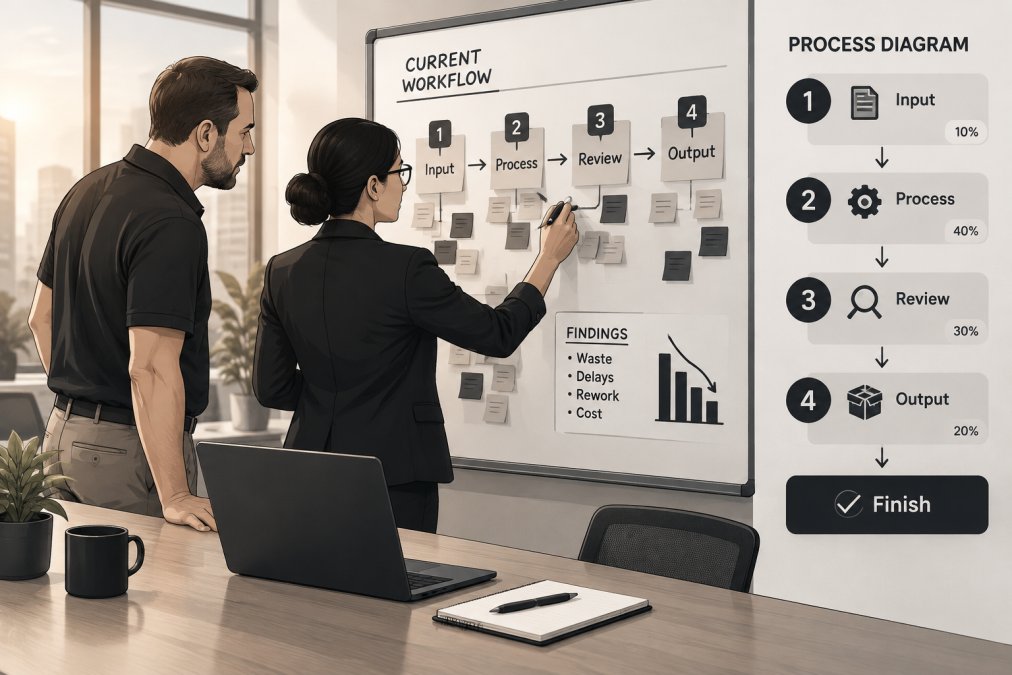
Start by writing down every step of one process, exactly as it happens today. Not how it should work. How it does.
Pick a process that hurts: invoicing, job intake, change orders, or scheduling. Then walk it end to end and note three things for each step:
- Who touches it
- How long it waits before the next step
- Where information gets re-entered
The waiting is the finding. Most small business waste hides between steps, not inside them. A common mistake is timing only the work and ignoring the handoffs, where days disappear.
For a deeper walkthrough, see our guide on simplifying small business manual processes. Once you have found the bottlenecks, our step-by-step guide on how to fix project bottlenecks shows what to do next.
Business Process Improvement Methodologies Worth Using
Four methodologies cover most small business needs. You do not need all of them.
Lean targets waste: extra steps, waiting, rework, and motion. It fits service and construction work well because the waste is visible.
Six Sigma and DMAIC (Define, Measure, Analyze, Improve, Control) suit processes where error rates matter, like estimating or billing accuracy.
Kaizen is small, continuous improvement driven by the people doing the work. It costs nothing and builds employee engagement.
Business process reengineering means rebuilding a process from scratch. Use it rarely, and only when a process is beyond repair.
Methodology matters less than discipline. A simple Lean walk-through run every quarter beats a Six Sigma program nobody maintains.
A Business Process Improvement Framework You Can Follow
Use this five-step framework. It works for a two-person shop or a fifty-crew contractor, and it is built so you can run it with a spreadsheet and a whiteboard rather than a consulting engagement.
Step 1: Select the process. Do not start with the process that annoys you most. Start with the one that scores highest on a simple impact-and-feasibility screen. Score each candidate process from 1 to 5 on four factors:
- Customer impact: how directly does this process affect what a customer receives or pays?
- Financial impact: how much cash, margin, or billable capacity is tied up in it?
- Risk: what happens if it fails, and how often does it fail?
- Feasibility: how much authority, budget, and staff time will the fix require?
Multiply the impact score by the feasibility score, then divide by the effort score. The formula is (Impact x Feasibility) / Effort. A process that is easy to implement and has high impact will score highest. Higher feasibility pushes the score up, while higher effort pushes it down. A process that touches every customer but requires a software migration can wait behind one that leaks cash and can be fixed with a form. Most practitioners find that two or three processes account for the majority of the pain, so resist the urge to fix everything at once.
Step 2: Baseline it. Measure the current state before you change anything. You need four numbers for each process:
- Cycle time: start to finish, including waiting time between steps
- Error or rework rate: how often the output has to be corrected or redone
- Cost per transaction: labor hours multiplied by loaded hourly rate, plus any direct materials
- Volume: how many times the process runs per week or month
Pick one leading indicator and one lagging indicator. A leading indicator is something you can influence early, such as the percentage of job tickets captured at close. A lagging indicator is the outcome, such as days sales outstanding or invoice accuracy. Set a target that is realistic against your own baseline, not against an industry benchmark you cannot verify. If your invoice cycle is six days, a target of four days in 90 days is credible; a target of one day is not, and a missed target erodes trust in the whole effort.
Step 3: Map it. Document each step, the owner, the handoff, and the wait time. Use a simple swimlane on a whiteboard or a shared document. The goal is not a beautiful diagram; it is a shared picture of where the work actually goes. Mark every point where information is re-entered or a decision waits on someone's inbox.
Step 4: Redesign it. Apply three moves in order. First, remove steps that do not change the output. Second, combine handoffs so one person owns a sequence instead of passing it along. Third, assign a single process owner who is accountable for the result, not just a participant. Only after those three moves should you consider automation. Automating a process you have not simplified locks the waste in place.
Step 5: Control it. Write the standard operating procedure in plain language, post it where the work happens, and set a review date. Record the baseline numbers and the target in the same document so the next review has something to compare against.
Watch out: the baseline step is the one everyone skips. Without it, you cannot prove the change worked, and your team stops believing in the next one. A framework run without a baseline is just a meeting.
If you want a reusable worksheet for steps 1 through 5, our business process improvement template is built to be filled in for one process in a single sitting.
Business Process Improvement Examples from Service and Construction
Two examples show how this plays out in practice.
These are typical business process improvement examples: small, specific, and unglamorous. If you run a trade business, our article on how contractors boost operational efficiency covers more of these patterns.
Your Business Process Improvement Template
Copy this template and fill it in for one process this week.
Field | What to Write | Example |
|---|---|---|
Process name | The exact process | Invoice creation |
Process owner | One named person | Office manager |
Trigger | What starts it | Job marked complete |
Steps | Numbered list | 1. Ticket collected, 2. Hours entered |
Cycle time | Start to finish | 6 days |
Error rate | Rework per month | 4 corrections |
Top bottleneck | The worst wait | Ticket sits in truck |
Fix | One change | Photo ticket at close |
Review date | When to recheck | 90 days |
Fill one row per process. Keep it to one page. A template you actually use beats a binder nobody opens.
Sustaining Gains After You Implement Changes
Improvements decay. People drift back to old habits within weeks unless the new process is easier than the old one and someone is accountable for keeping it that way. Most guides stop at implementation; the work that determines whether the gain survives starts after the change goes live.
Build a one-page control plan for every process you fix. It should name four things:
- The process owner, by name, not by role
- The standard operating procedure and where it lives
- The metric being watched, with its baseline and target
- The review cadence and who attends
A control plan is not bureaucracy. It is the difference between a fix that holds and a fix that quietly reverts. Keep it to one page and store it where the process owner will actually see it.
Run a short audit on a fixed cadence. A monthly fifteen-minute check is enough for most small businesses: pull the metric, compare it to the target, and ask the owner one question, what changed since last month? Quarterly, do a deeper review that walks the process end to end and confirms the steps still match the written procedure. Processes drift when a workaround becomes permanent and nobody notices.
Close the feedback loop with the people doing the work. The crew that runs the process sees the failure points first. Give them a standing way to report a problem, a weekly huddle item, a shared note, a five-minute conversation, and act on what they raise. A process owner who ignores frontline feedback will find the old workaround back within a quarter.
Watch out: naming a process owner without giving them the authority to enforce the standard is the most common failure. If the owner cannot say no to an exception, the exception becomes the new process.
Change management matters here. Tell your team why the change exists, let the people doing the work shape the fix, and recognize the ones who adopt it early. Employee engagement is the difference between a process that sticks and one that quietly dies.
As you grow, you will need to hand off steps you currently hold. Our guide on how to delegate business tasks covers that transition, and the same control-plan discipline applies to every process you hand over.
Examples
A small roofing contractor: estimates were built by hand in spreadsheets and took two days to send. Scoring showed high impact and high feasibility with low effort, so the team moved to a standard estimate template first and now sends quotes the same day.
A cleaning service: crews kept missing supplies on site. A simple checklist filled out the night before each job scored high on feasibility and low on effort, so it went ahead of a bigger scheduling software change.
An HVAC service company: invoices went out weeks after jobs closed. Sending the invoice from the job site when the work is signed off was quick to set up and improved cash flow, so it ranked at the top of the list.
Book a Process Review with Roam Six
You do not have to find these bottlenecks alone. Roam Six runs accounting, operations, marketing and sales for contractors and small businesses..
Full service is $2,500 a month, and you can start with a $250 business audit to see where your business stands.
If your team is drowning in spreadsheets and rework, the fix starts with one honest map of one process. Get started with Roam Six with a $250 business audit.
Frequently Asked Questions
What is business process improvement?
Business process improvement is a structured way to examine how work gets done, find the steps that waste time or money, and redesign them so the same team produces more with fewer errors. It relies on process mapping, root cause analysis, and performance measurement rather than guesswork. For a small business, the goal is practical: shorter cycle time, fewer defects, lower cost, and happier customers, all without adding headcount.
What are the most common business process improvement methodologies?
Lean focuses on removing waste and non-value steps. Six Sigma and DMAIC use data to reduce defects and variation. Kaizen runs small, continuous improvements with employee engagement. Business process reengineering rebuilds a process from scratch when incremental fixes will not work. Most small businesses do best starting with Lean and Kaizen, then adding DMAIC tools once they have a baseline and reliable data.
How do you measure the success of a process improvement?
Pick a baseline before you change anything, then track the same key performance indicators after. Common measures include cycle time, throughput, defect rate, error rate, cost per transaction, and customer satisfaction. Set a target and a review date, and assign a process owner to watch the numbers. Without a baseline, you cannot prove the change worked or justify the next project.
How can a small business identify process bottlenecks?
Walk the process end to end and note where work piles up, waits, or gets reworked. Ask the people doing the job where they lose time, then confirm with data such as how long each step takes or how often it fails. Look for manual handoffs, spreadsheet duplication, and approval queues. Rank the bottlenecks by impact and feasibility, and fix the highest-value one first.