 comparison
Top Management Consulting Firms for Small Business Scaling
Table of Contents
- How to Evaluate Management Consulting Firms for Small Business Scaling
- Small Business Operations Consulting: What to Expect
- Top-Rated Management Consulting Firms for Scaling Operations
- Business Scaling Consultants: Engagement Models and Pricing
- Business Process Improvement Consulting for Operational Efficiency
- Small Business Growth Strategy Consulting: Implementation Support
- Conclusion
- Frequently Asked Questions
Last Updated: October 13, 2026
How to Evaluate Management Consulting Firms for Small Business Scaling
Finding the right management consulting firms for small businesses that specialize in scaling operations comes down to five things: proven operational outcomes, affordable engagement models, implementation support, industry fit, and transparent pricing. Most small businesses get this wrong by hiring on brand name alone.
That mistake is expensive: an enterprise-focused firm may send junior staff, bill for a strategy deck, and leave before anything changes. This guide from Roam Six covers what to check before you sign.
Selection Criteria Tailored to Small-Business Scale
Small and midsize firms need someone who will sit in your operations, not just present to your board. Screen candidates on:
- Typical client size. Ask what revenue range most clients fall into. If you are a $3M company and their average client is $200M, you are a small account to them.
- Implementation support. Will they help you execute, or hand over a report? Ask who does the work and for how long.
- Engagement structure. Flat-rate projects, monthly retainers, and hourly billing all change your risk. Know which one you are buying.
- Industry specialization. A firm that knows commercial construction understands retainage, lien waivers, and seasonal cash flow. A generalist learns on your dime.
- Knowledge transfer. The best engagements leave your team more capable, not more dependent.
U.S. Small Business Administration guidance on choosing business advisors recommends checking references and clearly defining scope before engaging any advisor.
Small Business Operations Consulting: What to Expect
Small business operations consulting focuses on how work actually gets done: workflows, capacity, resource allocation, and where money leaks out. It is hands-on work, not theory.
A typical engagement starts with a diagnostic. The consultant maps your current processes, interviews your team, and identifies bottlenecks.
What separates good operations consulting from a generic business review is specificity: recommendations like "consolidate the three spreadsheets your dispatch team uses into one board" rather than "improve communication."
Common deliverables include:
- A process map of your core workflows
- A capacity plan showing where you are over- or under-resourced
- Cost reduction targets with named owners
- A 90-day implementation roadmap
Top-Rated Management Consulting Firms for Scaling Operations
The best management consulting firms for small business scaling combine operational depth with implementation support at a scale you can afford. Five options worth evaluating, starting with our own firm.

Roam Six
Roam Six is a veteran-owned consulting firm built specifically for small businesses, service industries, and commercial construction contractors.
Best for: Service businesses and contractors doing roughly $1M to $20M in revenue that need operational fixes and funding support together.
Pros: Veteran-owned; comprehensive service range including funding and risk management; deep focus on service and construction businesses.
Cons: We are not the right fit for companies looking only for a one-time strategy report with no implementation.
Covision Consultants
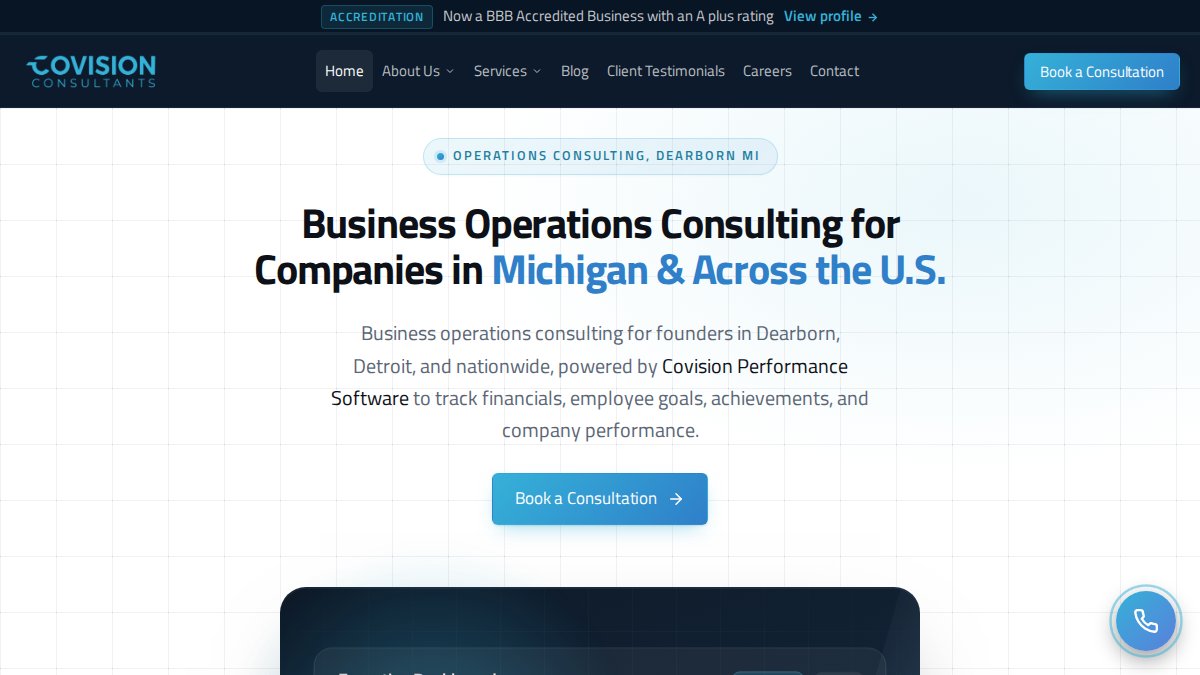
Covision Consultants publishes a guide to operations consulting firms for small businesses and lists itself first.
Best for: Small businesses that want a starting point for comparing operations consulting options.
Pros: The guide is aimed specifically at small-business operations consulting and covers multiple firms.
Cons: Self-ranked first, so the comparison has a clear conflict of interest; service details and pricing are unverified.
Scaling.com
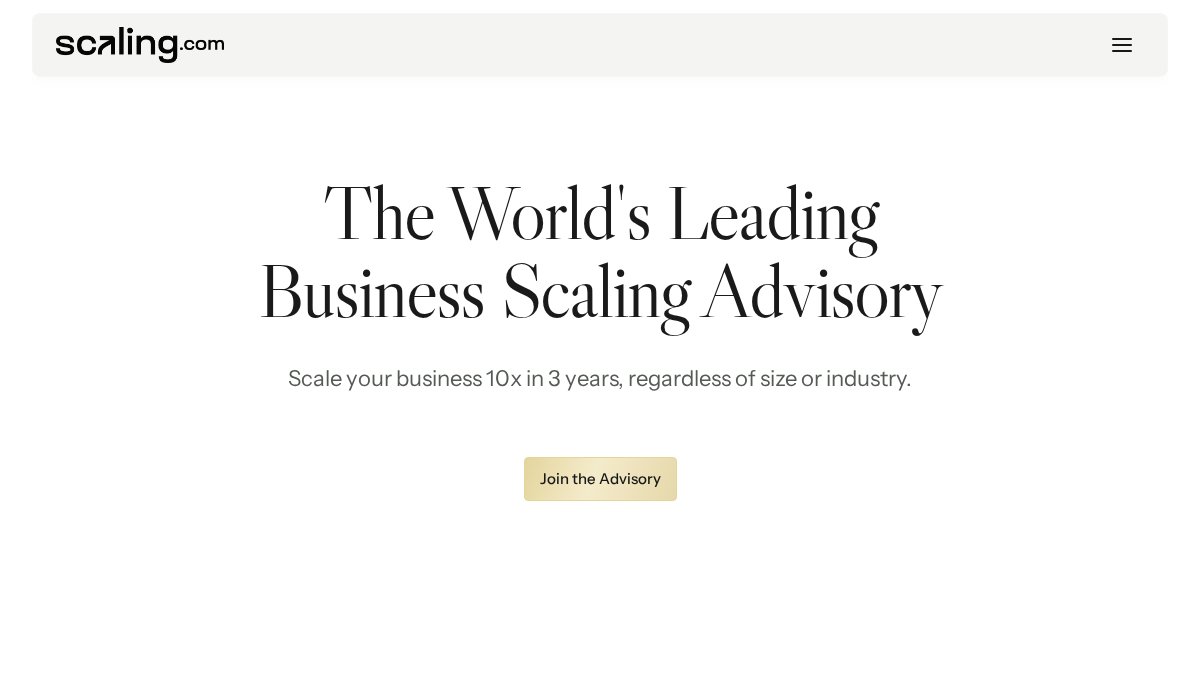
Scaling.com offers a business-scaling system built around establishing a vision, defining a pathway, and developing talent, and states it serves businesses from $1 million to more than $1 billion in revenue.
That range is the thing to watch: a firm serving both $1M and $1B companies is unlikely to tailor its core system to small-business constraints.
Best for: Businesses that want a structured, framework-driven approach to growth.
Pros: Explicit focus on scaling; spans multiple revenue levels.
Cons: No verified pricing or engagement details; not clearly tailored to small businesses.
Consultport
Consultport is a directory, not a consulting firm. It lets you browse and compare providers by industry, country, budget, and company size, useful for shortlisting rather than hiring.
The filters are genuinely helpful, but a listing only tells you a firm exists and fits your filters, not whether it delivers operational results.
Best for: Small businesses that want to compare many firms against budget and company-size criteria.
Pros: Multiple relevant filters; supports side-by-side comparison.
Cons: A finder tool, not a provider; specific scaling services and pricing are unverified.
Scaling Up
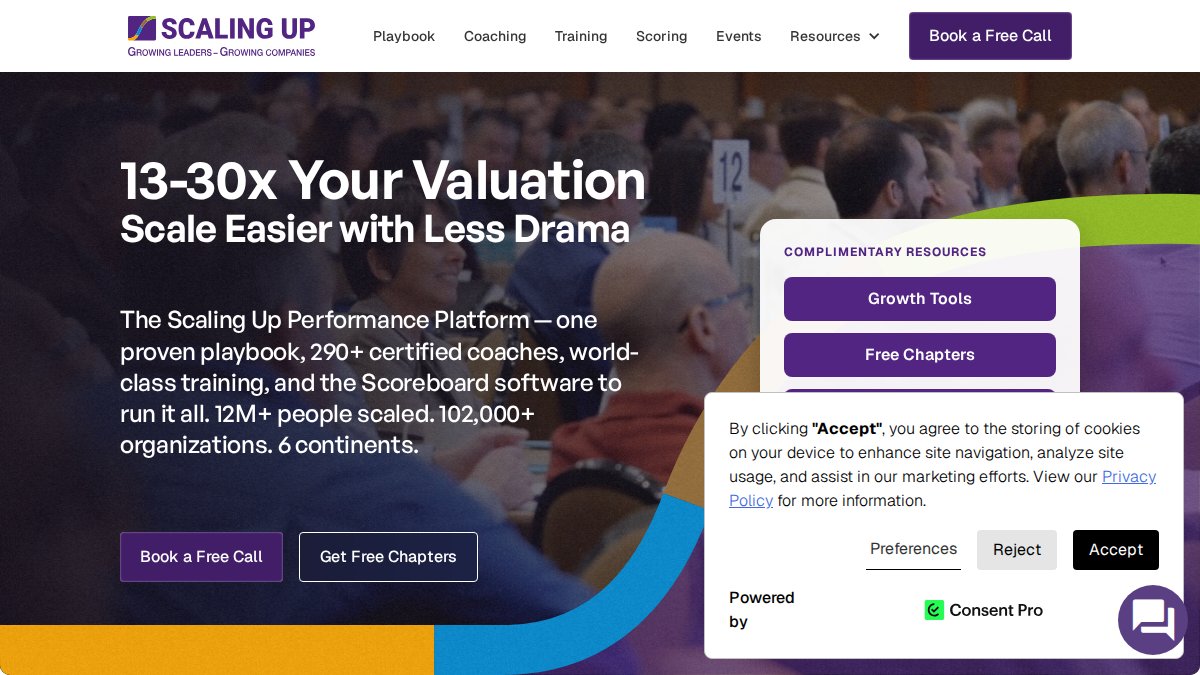
Scaling Up offers a business book and tools organized around People, Strategy, Execution, and Cash; the site states more than 102,000 firms use its tools.
This is a framework and toolkit, not a consulting engagement.
Best for: Owners who want a self-guided growth framework and practical tools.
Pros: Covers people, strategy, execution, and cash in one model; widely used.
Cons: A book and tools rather than a consulting firm; no confirmed hands-on services.
| Firm | Type | Best For | Pricing Transparency |
|---|---|---|---|
| Roam Six | Full-service consulting | Service and construction SMBs needing operations plus funding | Flat-rate, contact for quote |
| Covision Consultants | Operations consulting | Shortlisting operations firms | Contact for pricing |
| Scaling.com | Scaling system | Framework-driven growth | Contact for pricing |
| Consultport | Directory | Comparing many firms | Not stated |
| Scaling Up | Book and tools | Self-guided owners | Not stated |
Business Scaling Consultants: Engagement Models and Pricing
Project-based (flat rate). You pay a set fee for a defined scope, such as a 90-day operations overhaul.
Monthly retainer. You pay a recurring fee for ongoing access and support, best when you need continuous help with cash flow, hiring, and process work.
Performance-based or hybrid. A reduced base fee plus a success fee tied to a measurable outcome, such as documented cost savings or throughput gains.
Pricing depends on scope, team size, and engagement length.
| Model | Best For | Main Risk | What to Ask |
|---|---|---|---|
| Project-based (flat rate) | Bounded problems, cost certainty | Scope creep | What triggers a change order? |
| Monthly retainer | Ongoing operations support | Minimum terms | What is the minimum and the exit clause? |
| Hourly | Tightly scoped diagnostics | Rewards slow work | Who is billing and at what rate? |
| Performance-based / hybrid | Outcome-aligned engagements | Baseline disputes | How is the baseline set and measured? |
Business Process Improvement Consulting for Operational Efficiency
Business process improvement consulting targets the workflows that slow you down and cost you money. The goal is measurable operational efficiency, not a prettier org chart.
In service and construction businesses, waste usually appears in three places: duplicate data entry across spreadsheets and email chains, scheduling that ignores real crew capacity, and invoicing that lags behind completed work.
A good process improvement engagement will:
- Document each core workflow step by step
- Identify handoffs where information gets lost
- Redesign the workflow to remove duplicate steps
- Set a baseline metric so you can prove the change worked
The Operational Scaling Metrics That Prove It Worked
Without a baseline, you cannot tell whether the process improvement delivered. Pick two or three of these measures before the engagement starts, record the current number, and track it after:
- Throughput. How many jobs, orders, or service calls you complete per week. A process fix should raise this without adding headcount.
- Cycle time. How long it takes from job start to job completion, or from work finished to invoice sent. Shorter cycle time means faster cash.
- Cost per unit. Your cost to deliver one job, one unit, or one service call. Falling cost per unit at steady volume is the clearest sign of real efficiency.
- Capacity utilization. The share of your crew's or equipment's available hours that are billable. Low utilization usually points to scheduling and handoff problems, not lazy staff.
- Service quality. Rework rate, callback rate, or customer complaints per hundred jobs. A process that speeds things up but raises rework is not an improvement.
Owners often track revenue and profit but never the operational inputs that drive them. Start measuring cycle time and utilization, and the bottleneck usually becomes obvious within weeks.
What a Diagnostic Should Produce
A typical engagement starts with a diagnostic: the consultant maps your processes, interviews your team, and identifies bottlenecks, then delivers a prioritized list of fixes ranked by impact and effort.
Common deliverables include:
- A process map of your core workflows
- A capacity plan showing where you are over- or under-resourced
- Cost reduction targets with named owners
- A 90-day implementation roadmap
- A baseline scorecard for the metrics above, with target values
Project Management Institute research on process maturity shows that organizations with mature process practices report better project outcomes.
Small Business Growth Strategy Consulting: Implementation Support
Small business growth strategy consulting only pays off with implementation support. A strategy that lives in a slide deck changes nothing.
This is where most small businesses get burned. They pay for recommendations, the consultant leaves, and the plan dies in a folder.
Strong implementation support looks like this:
- The consultant works inside your business on a set schedule
- Your team gets trained on the new processes, not just told about them
- Progress gets reviewed against the baseline metrics
- The engagement ends with your team able to run the system without outside help
Revenue growth and cost reduction are the two levers most engagements pull. The order matters. Fixing cash flow and margin first gives you the money to fund growth second.
Conclusion
Scaling a small business exposes every weak process at once, and most owners hit a wall trying to fix operations, cash flow, and growth strategy alone. Roam Six was built for that moment: a veteran-owned firm serving small businesses, service companies, and commercial construction contractors with hands-on support across operations, financial funding, risk management, and leadership development. If you want a partner who stays through implementation rather than handing you a report, get started with Roam Six.
Frequently Asked Questions
Which consulting firms help small businesses scale their operations?
Several firms specialize in helping small businesses scale operations. Roam Six focuses on small businesses, service industries, and construction contractors with services including financial funding, risk management, and leadership development. Covision Consultants publishes a guide specifically for small-business operations consulting. Scaling.com offers a structured system for business scaling. Consultport provides a directory to compare firms by industry, budget, and company size. Scaling Up offers a framework organized around People, Strategy, Execution, and Cash.
What should a small business look for in a management consulting firm?
Look for a firm with experience in your industry and company size. Check whether they offer implementation support or just recommendations. Ask about their pricing model and whether they provide transparent, flat-rate fees. Verify their expertise in scaling operations, process improvement, and financial planning. A good fit will have a clear methodology for operational scaling and evidence of measurable outcomes for similar businesses.
How much does small business management consulting cost?
Pricing for small business management consulting varies widely based on the firm, engagement scope, and your company's revenue. Some firms charge project-based flat rates, while others use monthly retainers or hourly billing. Because costs depend on your specific needs, request a quote directly from firms you are considering. Roam Six, for example, offers flat-rate pricing; contact them for details tailored to your situation.
How long does an operations consulting engagement usually take?
Engagement length depends on the scope of work and the firm's approach. Some projects focused on a single process improvement may last a few weeks, while comprehensive operational scaling engagements can run several months. Firms that provide implementation support often stay involved longer to help with organizational change and knowledge transfer. Discuss timelines during your initial consultation.